A Specifier’s Guide to Ratings
Behind every beautiful lighting design is a layer of technical detail that ensures the fixtures we specify don’t just look good, they perform reliably and safely in the environments we place them in. Ratings and certifications provide that assurance. They tell us whether a fixture can handle moisture, impact, vibration, or outdoor conditions, and confirm that it meets essential safety standards.
In this issue, we’ll explore some of the most common ratings you’ll encounter as a specifier, and why understanding them is key to delivering designs that are not only visually compelling, but also durable, code-compliant, and built to last.
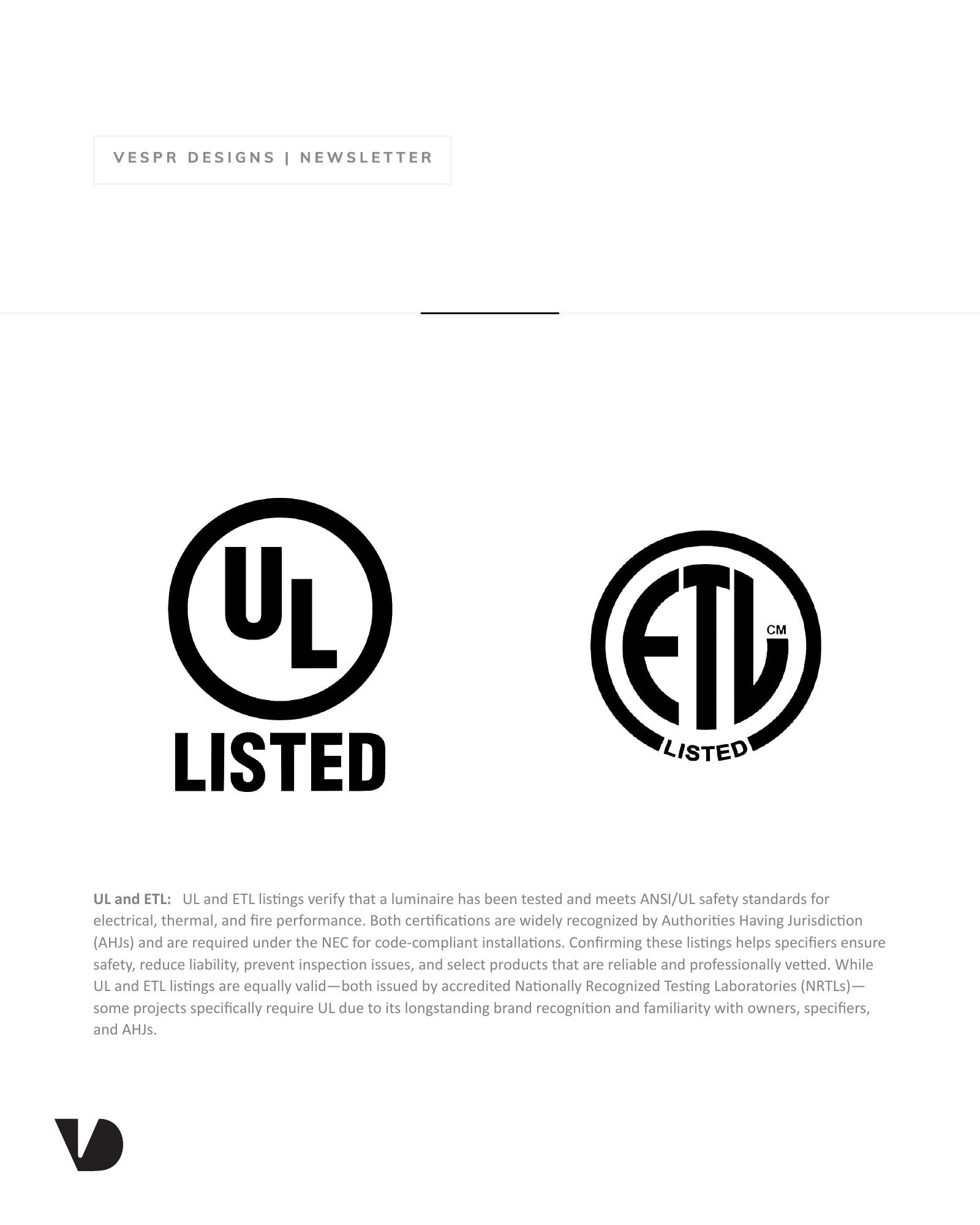
UL and ETL
UL and ETL listings verify that a luminaire has been tested and meets ANSI/UL safety standards for electrical, thermal, and fire performance. Both certifications are widely recognized by Authorities Having Jurisdiction (AHJs) and are required under the NEC for code-compliant installations. Confirming these listings helps specifiers ensure safety, reduce liability, prevent inspection issues, and select products that are reliable and professionally vetted. While UL and ETL listings are equally valid, both issued by accredited Nationally Recognized Testing Laboratories (NRTLs), some projects specifically require UL due to its longstanding brand recognition and familiarity with owners, specifiers, and AHJs.
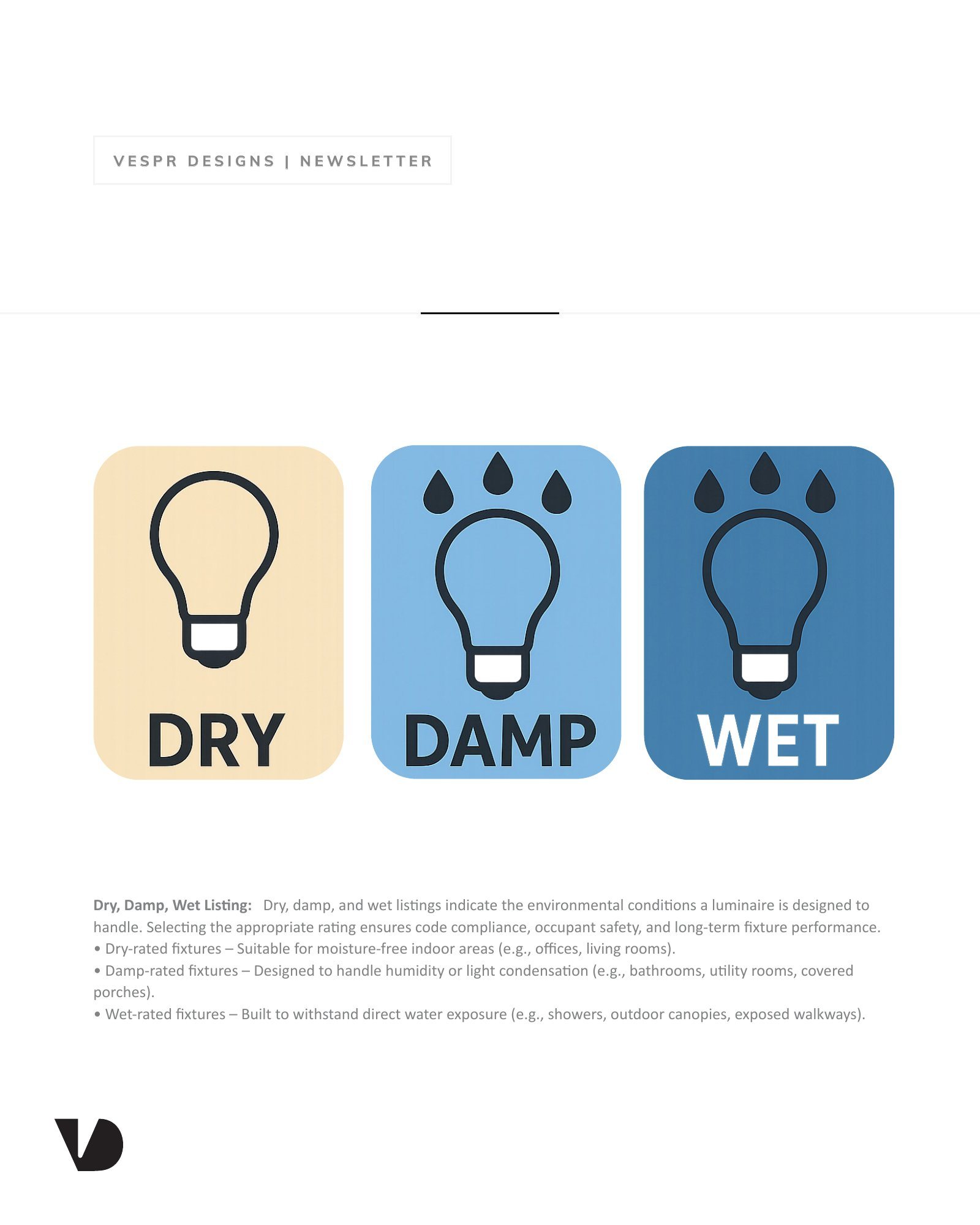
Dry, Damp, and Wet Listings
Dry, damp, and wet listings indicate the environmental conditions a luminaire is designed to handle. Selecting the appropriate rating ensures code compliance, occupant safety, and long-term fixture performance.
Dry-rated fixtures, Suitable for moisture-free indoor areas (e.g., offices, living rooms).
Damp-rated fixtures, Designed to handle humidity or light condensation (e.g., bathrooms, utility rooms, covered porches).
Wet-rated fixtures, Built to withstand direct water exposure (e.g., showers, outdoor canopies, exposed walkways).
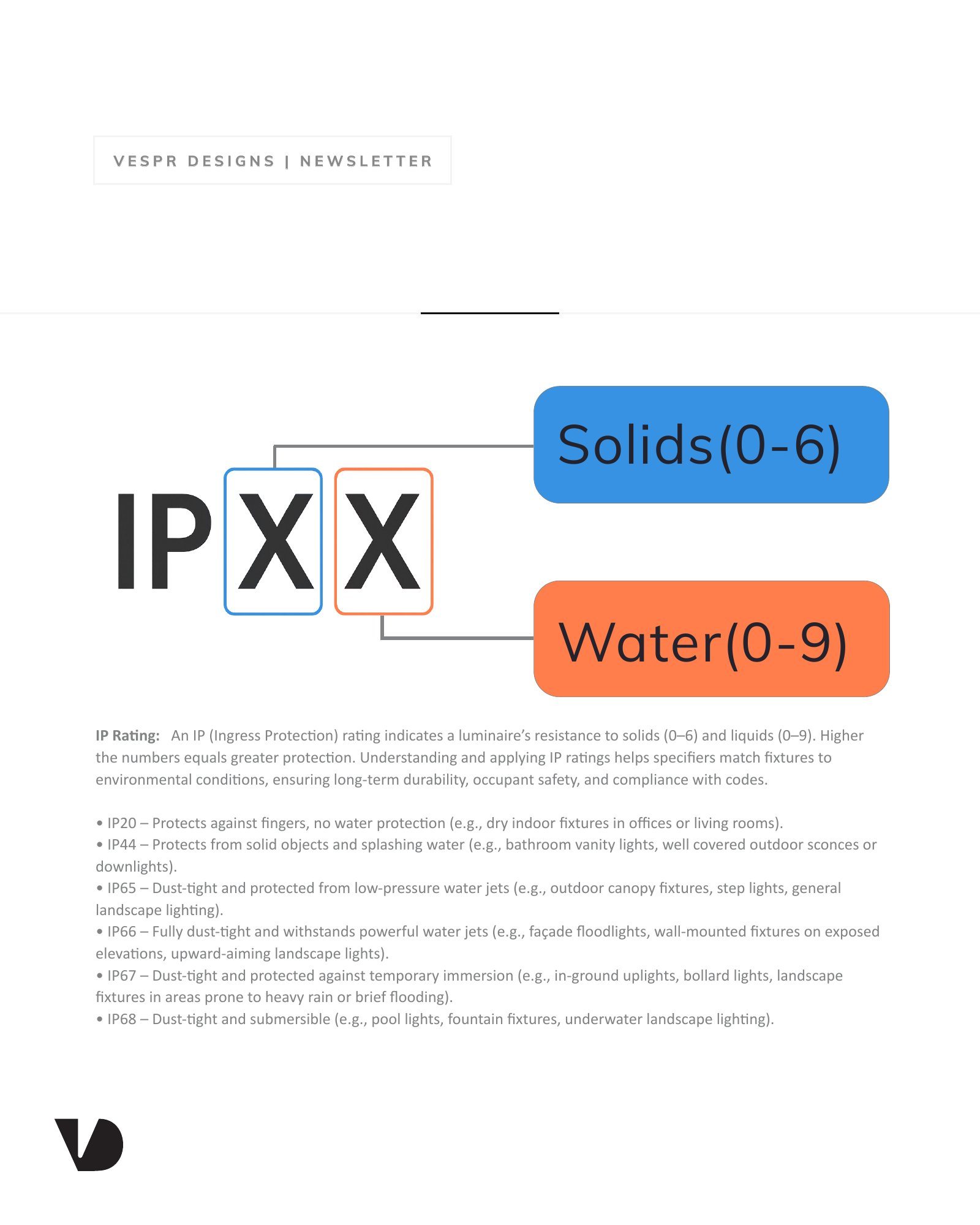
IP Rating
An IP (Ingress Protection) rating indicates a luminaire’s resistance to solids (0, 6) and liquids (0, 9). The higher the numbers, the greater the protection. Understanding and applying IP ratings helps specifiers match fixtures to environmental conditions, ensuring long-term durability, occupant safety, and compliance with codes.
IP20, Protects against fingers, no water protection (e.g., dry indoor fixtures in offices or living rooms).
IP44, Protects from solid objects and splashing water (e.g., bathroom vanity lights, well-covered outdoor sconces or downlights).
IP65, Dust-tight and protected from low-pressure water jets (e.g., outdoor canopy fixtures, step lights, general landscape lighting).
IP66, Fully dust-tight and withstands powerful water jets (e.g., facade floodlights, wall-mounted fixtures on exposed elevations, upward-aiming landscape lights).
IP67, Dust-tight and protected against temporary immersion (e.g., in-ground uplights, bollard lights, landscape fixtures in areas prone to heavy rain or brief flooding).
IP68, Dust-tight and submersible (e.g., pool lights, fountain fixtures, underwater landscape lighting).
IK Rating
An IK rating measures a luminaire’s resistance to mechanical impacts, ranging from IK00 (no protection) to IK10 (able to withstand strong impacts up to 20 joules, like vandalism or accidental strikes). This rating is essential for public, industrial, and exterior spaces, helping ensure fixture durability, reduce maintenance needs, and maintain long-term performance in harsh or high-traffic environments.
IK07, Moderate impacts (2 joules); public corridors, gyms, stairwells.
IK08, Strong impacts (5 joules); commercial lobbies, schools, semi-public spaces.
IK10, Heavy impacts (20 joules); high-traffic public areas, outdoor walkways, spaces prone to vandalism.
Vibration Rating
A vibration rating, typically per ANSI C136.31, indicates a luminaire’s ability to withstand mechanical vibrations (e.g., 1.5G, 3G) without performance loss. This is important for installations on bridges, roadways, rail stations, or industrial sites, ensuring long-term reliability, reducing maintenance, and preventing premature fixture failure.
1.5G rating, Light vibrations; suitable for standard roadway lighting or general urban street lighting.
3G rating, Moderate vibrations; ideal for bridges, overpasses, or elevated roadways.
5G rating, High vibrations; used in rail stations, industrial machinery areas, or heavy transit environments.
Knowing a fixture’s ratings and certifications allows us to design with confidence, balancing beauty and performance. By understanding how luminaires handle moisture, impact, vibration, and outdoor conditions, we ensure our lighting is safe, durable, code-compliant, and built to shine for years to come.
See the original newsletter (7 pages)