Color Lighting in Space: Explore Color Lighting to Create Your Special Scenes
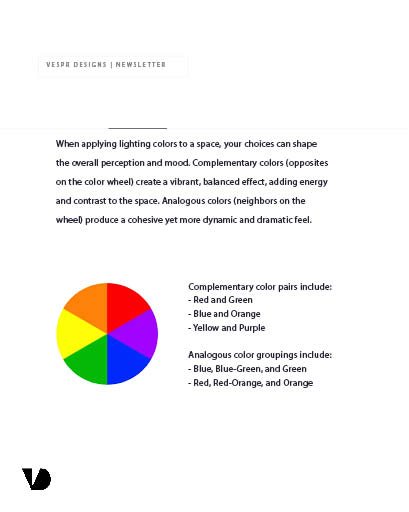
When applying lighting colors to a space, your choices can shape the overall perception and mood. Complementary colors (opposites on the color wheel) create a vibrant, balanced effect, adding energy and contrast to the space. Analogous colors (neighbors on the wheel) produce a cohesive yet more dynamic and dramatic feel.
Complementary and Analogous Colors
Complementary color pairs include:
Red and Green
Blue and Orange
Yellow and Purple
Analogous color groupings include:
Blue, Blue-Green, and Green
Red, Red-Orange, and Orange
Color Mixing
Color mixing in lighting involves two main techniques: additive and subtractive color mixing, both of which are used to create a wide variety of lighting colors.
Additive color mixing: This method combines red, green, and blue (RGB) light to create white light. Mixing these primary colors produces other colors, such as:
Red and green: Yellow
Green and blue: Cyan
Blue and red: Magenta
All three colors combined: White
Additive color mixing is the dominant method used in modern LED fixtures for producing a broad spectrum of colors.
Subtractive color mixing: This approach begins with a white light source and uses filters to block specific wavelengths of light. Known as CMY (Cyan, Magenta, Yellow) color mixing, this technique allows filters to combine in different ways to generate various colors. For instance, mixing magenta and yellow results in red, while combining magenta at half saturation with cyan at full saturation produces a sky blue hue.
See the original newsletter (2 pages)