Measured Light Level vs. Perceived Light Level
Our eyes possess a remarkable ability to adapt to varying ambient illumination by dynamically adjusting the size of our pupils, regulating the amount of light entering our vision.
This continuous adjustment allows us to perceive brightness despite changes in the overall ambient lighting conditions, enabling us to see clearly in both bright and dark environments.
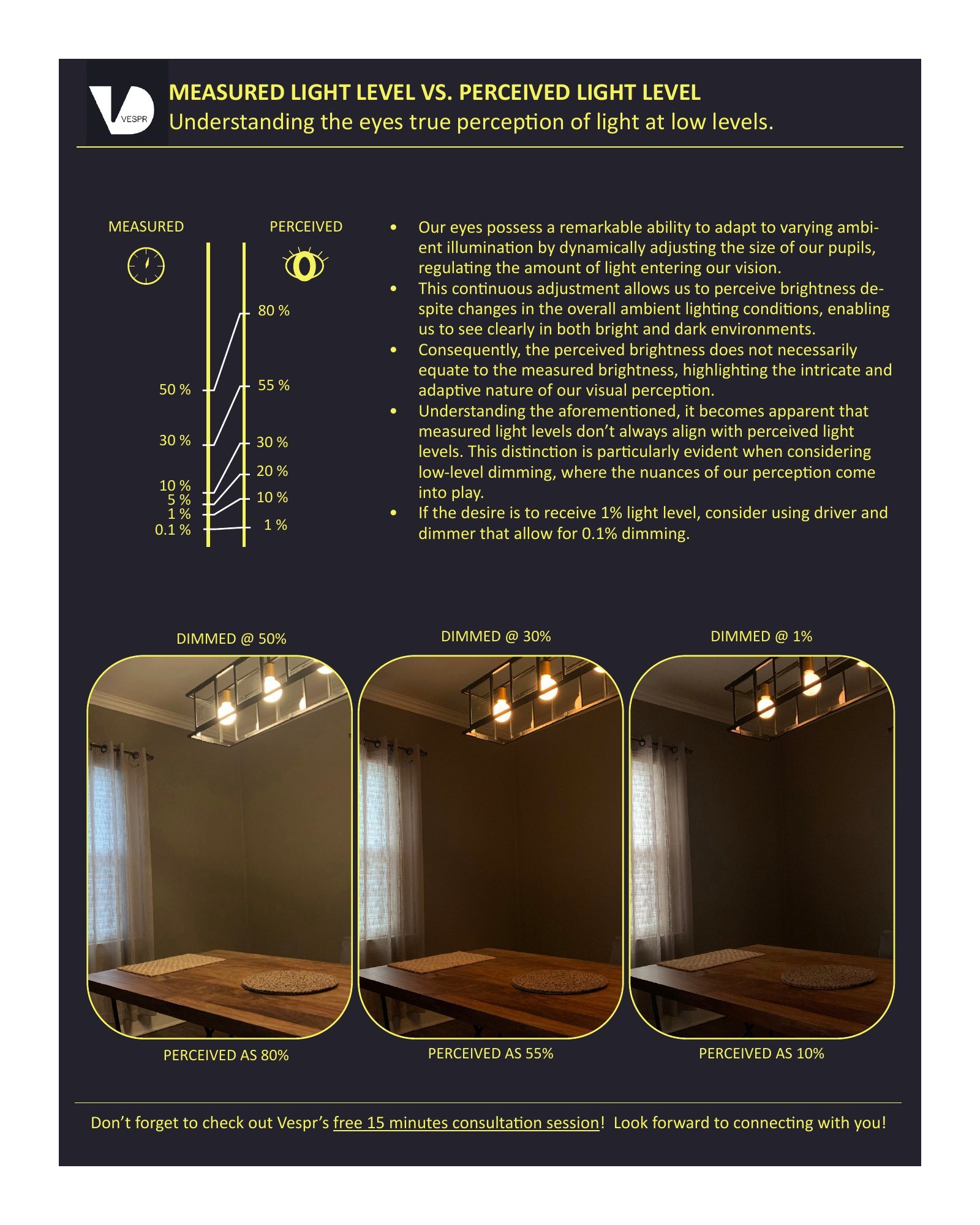
Consequently, the perceived brightness does not necessarily equate to the measured brightness, highlighting the intricate and adaptive nature of our visual perception.
Understanding the aforementioned, it becomes apparent that measured light levels don’t always align with perceived light levels. This distinction is particularly evident when considering low-level dimming, where the nuances of our perception come into play.
If the desire is to receive a 1% light level, consider using a driver and dimmer that allow for 0.1% dimming.
Measured vs. Perceived
Dimmed at 50%: perceived as 80%
Dimmed at 30%: perceived as 55%
Dimmed at 10%: perceived as 30%
Dimmed at 5%: perceived as 20%
Dimmed at 1%: perceived as 10%
Dimmed at 0.1%: perceived as 1%
See the original newsletter (1 page)